

 Membership




Building High-Quality WLAN, Unlocking New Value for Home Broadband
— WAA-WBBA Asia-Pacific WLAN Industry Round Table
On 14 July 2026, the WAA-WBBA Asia-Pacific WLAN Industry Round Table took place at the Athenee Hotel in Bangkok, Thailand. Cohosted by The World WLAN Application Alliance (WAA) and World Broadband Association (WBBA), the seminar set "Building high-quality WLAN and elevating home broadband network value" as its core industry consensus objective. It brought together global operators, leading equipment vendors, industry experts and industrial-chain representatives including AIS, CMI, MTel, SURGE, SpectrLite Pte Ltd and HUAWEI. Participants focused on hot-button topics across the broadband sector and conducted in-depth discussions covering unified standards and certification, improvement of user experience, and exploration of industrial commercial value. Aligned with the theme "AI-Empowered Connectivity for Asia-Pacific", the event further consolidated WAA's core influence within the Asia-Pacific WLAN industry.
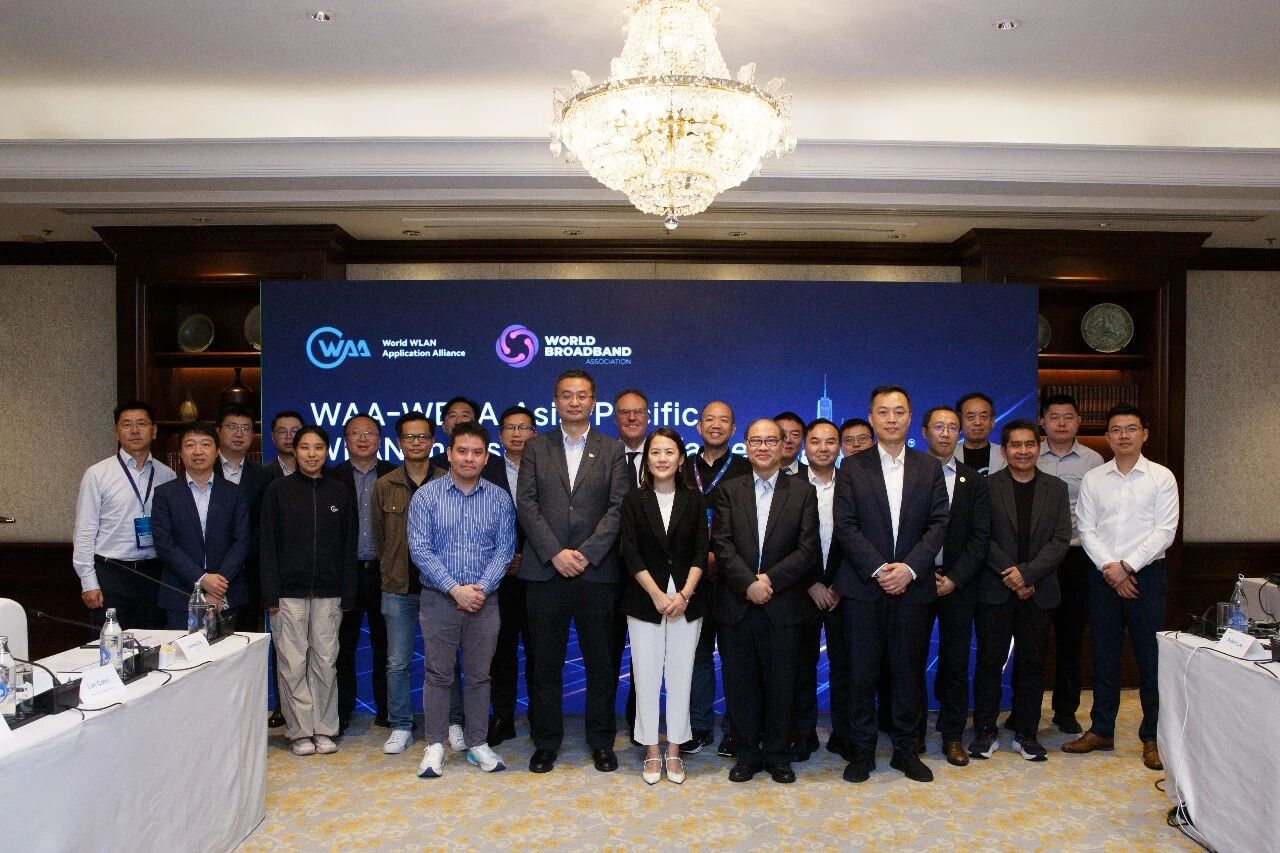
Crane Yang, Secretary-General of WAA, attended the conference and delivered a keynote speech titled "WAA: Provide the Best WLAN Experience for the Digital World", systematically analysing the current landscape and core challenges of the global WLAN industry. Martin Creaner, Director General of WBBA; Bonnie CHEN, Managing Director of China Mobile International (Thailand) Limited; Haipeng Zhai, Vice President of Optical Business Product Line, HUAWEI, and LEONG HOU HENG, Director of MTel Telecommunication Company Limited, delivered successive keynote sharing sessions. Marcus Brunner, Chair of WBBA Working Group 1; Yiou Deng, Secretary-General of NIDA, as well as operator representatives from multiple Asia-Pacific economies and technical experts from the industrial chain, actively participated in the roundtable in-depth dialogue, jointly exploring innovative breakthrough paths for the industry.
The global broadband industry has completed high-speed home access deployment. The industry bottleneck is shifting from the "last-mile" access segment to indoor WLAN experience challenges in the "last 50 feet". In the AI era, surging demand for high-definition audio-video, smart terminals and industrial-internet applications imposes stricter requirements on WLAN in terms of bandwidth, latency, roaming performance and stability. Meanwhile, lack of unified industry experience standards and operation-maintenance diagnostics, together with inconsistent service quality, have become key constraints hindering high-quality industrial development.
Against these industry priorities, attendees exchanged practical insights. China Mobile shared achievements in AI-driven proactive O&M and FTTR full-home optical network deployment. Leveraging edge-cloud collaboration and intelligent scheduling, networks are transforming from passive troubleshooting to proactive assurance. Improved user experience helps stimulate demand for home VAS, lifting ARPU while cutting operational expenditure. Huawei presented large-scale rollout results for WAA-certified products, optimising whole-home network performance via standardised technologies. Drawing on local cultural-tourism scenarios, Macau Telecommunications shared case studies on how upgraded WLAN experience fuels regional digital cultural-tourism development.
The roundtable forged several core industry consensuses. First, standardisation is the cornerstone for resolving experience-related pain points. Centred on WAA's scenario-oriented standard system, the industry shall unify six key metrics: bandwidth, coverage, latency, security, roaming and connectivity, and establish a tiered certification framework together with unified evaluation criteria for end-user experience. Second, AI-WLAN and integrated communication-sensing represent core evolutionary directions for next-generation networks. Accelerated technology implementation is required to address common challenges including indoor signal interference, high-density networking and roaming stuttering. Third, ecosystem collaboration is essential for industrial quality improvement and efficiency gains. WAA and WBBA will deepen strategic partnership through joint standard-setting, technology R&D and regional industry empowerment to facilitate resource exchange across the Asia-Pacific industrial chain. Fourth, enhanced user experience can unlock new commercial value. Supported by standardised certification and premium network services, differentiated value-added services can be realised, helping operators reduce costs, raise efficiency and tap new revenue streams.
Rooted in the Asia-Pacific region and responding to global broadband transformation demands, the Bangkok roundtable pointed the way forward for the standardised, intelligent and commercial-oriented development of Asia-Pacific WLAN through standard-driven foundations, technology-enabled capabilities and ecosystem-wide synergy. It will keep advancing high-quality upgrading of the worldwide WLAN industry.
WAA will continue to work with global clients and industry partners, pooling technological innovation and collective industrial wisdom to refine scenario-specific standards and test-and-certification systems, and jointly foster a new open, collaborative and win-win ecosystem for global WLAN and broadband industries.


